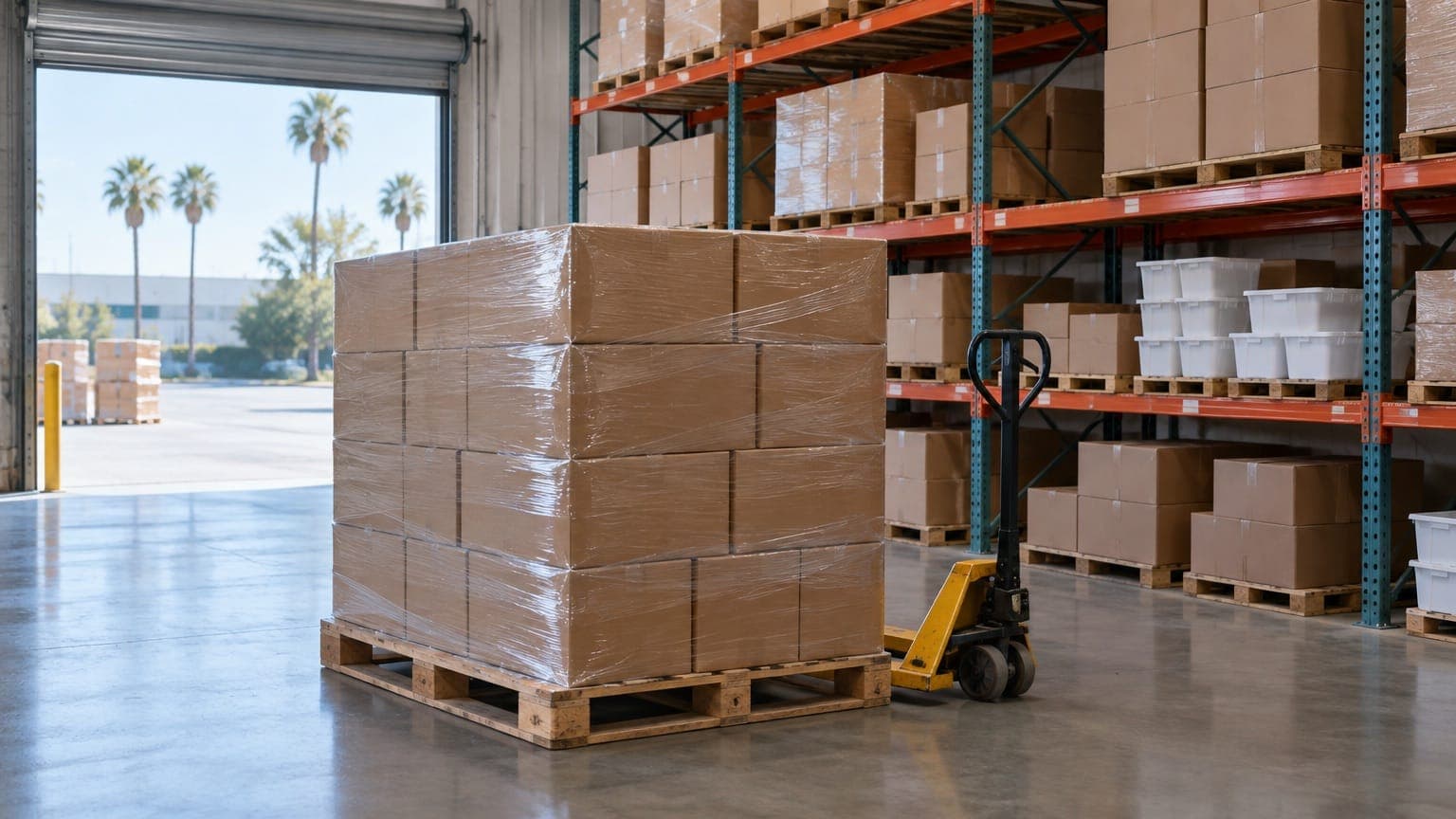
What Is a 3PL, and When Does Your Brand Need One?
Key takeaways
A 3PL is an outside company that stores your stock, packs and ships your orders, and handles returns. As of October 2026, Amazon suggests adding one past 10 orders a day, and a 2026 industry survey puts pick and pack at $3.21 per one-item order. More channels, retail and returns are other signs.
When should you sign with a US warehouse, and should you run your own?
Brands from Korea and the rest of Asia that are getting ready for the US ask us the same questions.
"When do we need a warehouse in the US?"
"Isn't Amazon FBA enough?"
"Can we wait until sales start and sign with a warehouse then?"
The short answer: not every brand needs a US 3PL on day one, but as your channels and order volume grow, a 3PL often stops being optional. Amazon's own FBA page suggests you "expand with 3PL when you start receiving more than 10 orders a day."
So what is a 3PL, when do you need one, and what does it cost?
What is a 3PL?
A 3PL (third-party logistics provider) is an outside company that takes over your warehousing, inventory management and order fulfillment (Amazon's guide to 3PLs).
In practice, a 3PL for ecommerce usually covers:
- Receiving: checking in your cartons or pallets when they arrive
- Storage: holding your stock, usually billed per pallet per month
- Pick and pack: taking each order's items off the shelf and packing them
- Shipping: parcels to shoppers, or pallets to retailers and wholesalers
- Returns: checking returned items and restocking the good ones
- Extra services: kitting (combining items into one unit, such as a gift set), labeling and FBA prep
For a brand that makes its products in Korea, a 3PL is a US stockroom and shipping team that you rent instead of build.
Do you need a US warehouse from day one?
No. While you test demand, sell samples or fill small first orders, shipping directly from Korea can work.
Direct shipping has limits, though. Every order crosses the Pacific on its own, so delivery is slow and shipping costs more per unit. A returned item has no easy way home.
Shipping from Korea works for a test, not as a long-term setup.
Four signs your brand needs a 3PL
Beyond Amazon's 10-orders-a-day rule, watch for these four signs.
1. You sell on more than Amazon
Many brands plan for Amazon FBA alone. Then a Shopify store, TikTok Shop, wholesale and retail orders add up. In Amazon's own words, "FBA is limited to the Amazon marketplace." But your other orders do not have to ship from a separate stock. Amazon's Multi-Channel Fulfillment (MCF) uses your FBA inventory to fill orders from your own website and other channels, Amazon also lists MCF as a supported fulfillment solution for TikTok Shop.
So the real question is which stock pool also fits wholesale pallets, retail labels and returns.
With two or more channels, you need one stock pool for all of them: MCF or a 3PL.
2. Returns start to pile up
Every US channel sends some product back, and shipping returns to Korea is slow and expensive. A US warehouse can inspect each return, repackage good units and put them back into stock. In The Fulfillment Advisor's 2026 survey of about 500 providers, 87% of warehouses charged for returns, at an average of $3.56 per single-item return.
A returned unit only has value if someone checks it and puts it back on sale close to the customer.
3. You are preparing for retail or wholesale
Retail and wholesale mean pallets and bulk cartons on the buyer's schedule, with the buyer's paperwork. One retailer, Academy Sports + Outdoors, trades six EDI documents (810, 850, 855, 856, 860 and 997), requires a GS1-128 label on every carton, and gives vendors 30 days to dispute a chargeback. EDI (electronic data interchange) is orders, shipping notices and invoices sent from computer to computer. GS1-128 is a standard barcode carton label. A chargeback is a deduction a retailer takes from your payment when a shipment breaks its rules.
Each retailer sets its own rules, and Academy is only one example. For retail, a US warehouse that builds pallets and follows each buyer's rules is close to a requirement, not an extra.
4. You sell on TikTok Shop or your own store
On TikTok Shop and your own store, shoppers see a delivery estimate before they pay. For a benchmark, Amazon's MCF promises delivery in two business days (Expedited) or three business days (Standard) from click to delivery. An order shipped from Korea has to cross the Pacific first.
Stock that already sits in the US lets you promise delivery in days, not weeks.
Is Amazon FBA enough? FBA vs MCF vs AWD vs a 3PL
Amazon FBA is enough only if you sell only on Amazon. AWD (Amazon Warehousing and Distribution) is Amazon's bulk storage that restocks FBA; Amazon's AWD page says "AWD pricing covers FBA inbound placement."
| Option | What it does | Orders it fills | Cost (source, October 2026) | Best fit |
|---|---|---|---|---|
| Amazon FBA | Amazon stores, picks, packs and ships | Amazon store orders only | Fee per unit by size and weight, plus storage (Amazon FBA) | Amazon-only sellers |
| Amazon MCF | Ships non-Amazon orders from your FBA stock | Your website, Shopify, WooCommerce, TikTok Shop | Fee covers pick, pack and shipping; delivery in 2 or 3 business days (Amazon MCF) | Amazon-led brands with some D2C |
| Amazon AWD | Bulk storage | Restocks FBA; can ship to other channels | $0.57 per cu ft per month West Coast, $0.48 East Coast (Amazon AWD) | Bulk stock for FBA |
| US 3PL | Holds your stock in an outside warehouse | Any channel: parcels, retail pallets, wholesale | $3.21 per one-item order, $19.37 per pallet per month (2026 survey averages) | Several channels, retail, many returns |
AWD bills per cubic foot and 3PLs bill per pallet, so do not compare those storage rates directly. For FBA fees on a real product, see what's left of $24.99 on each channel.
You can also combine them. For example, a 3PL holds the main stock, sends cartons to FBA as needed, and ships Shopify, TikTok Shop and retail orders itself.
FBA is Amazon's warehouse for Amazon orders. A 3PL is your warehouse for every channel.
Should you run your own warehouse instead?
You can, but the fixed costs come first and the orders come later. Your own warehouse means rent, staff, insurance, packing materials, carrier contracts, equipment and a WMS (warehouse management system: the software that tracks every unit and order). Amazon's 3PL guide lists the same cost types.
Those costs stay about the same at 50 orders a month or 5,000. A 3PL turns most of them into per-order and per-pallet charges.
The choice is not your own warehouse or a 3PL forever. It is which one fits your volume today. Revisit it when your volume is large and steady enough to keep your own staff busy.
How much does a 3PL cost in 2026?
3PL cost depends on volume, product size and region. The Fulfillment Advisor's 2026 Warehousing and Fulfillment Costs & Pricing Survey (August 2026, about 500 providers, about 80% in the US) reports these industry averages:
- Pick and pack, D2C order with one item: $3.21 ($2.73 base order charge + $0.48 for the item). Each extra item adds $0.48.
- Pick and pack, B2B order: $4.86 + $0.98 per item
- Storage: $19.37 per pallet per month, with reported rates from about $6 to $40
- Receiving: $8.75 per pallet, $2.25 per carton or $500 per container
- Monthly minimum: $752.08 on average, from $150 to more than $1,500
Receiving rates differ most between sources, so ask each 3PL to quote your own mix of cartons and pallets.
3PL for small business: check the monthly minimum first
If your bill for the month falls below the minimum, you pay the minimum.
For example, a brand that ships 100 one-item orders a month pays about $321 for pick and pack (100 orders × $3.21), well under the $752.08 average minimum, so the minimum sets the bill. At Amazon's 10 orders a day, about 300 a month, pick and pack alone is about $963 (300 orders × $3.21), above the average minimum.
Below the minimum, you pay for capacity you do not use. Above it, the bill follows your orders.
Why a 3PL in Orange County or Southern California helps for goods from Korea
A Southern California warehouse puts your stock close to the Los Angeles and Long Beach ports, where container ships from Korea arrive. The Port of Los Angeles 2025 Facts & Figures card gives the two ports 31% of US market share and lists South Korea as the Port of Los Angeles' fourth-largest trading partner in 2025, at $21 billion.
Transit is shorter too. These are industry estimates, port to port only:
- Busan to Los Angeles: about 20 days at the median, from 266 tracked sailings (SchedulesMCP lane data, as of October 15, 2026)
- Busan to Los Angeles or Long Beach: 13 to 21 days, against 25 to 35 days to New York/New Jersey (GoForwarder estimates)
Customs clearance and the truck to the warehouse come on top. See what you need for US customs, and before the holiday peak, our BFCM 2026 checklist for the dates.
The trade-off: West Coast storage often costs more. Amazon's AWD charges $0.57 per cubic foot per month on the West Coast against $0.48 on the East Coast, and one vendor source says tight coastal markets quote $30 to $45 per pallet per month (WarehousingCosts.com, October 2026).
For goods from Korea, a Southern California 3PL trades a higher storage rate for about two fewer weeks at sea on every restock.
What should a 3PL do beyond storage? Questions to ask before you sign
A good 3PL does more than hold boxes. Ask before you sign:
1. Can we see stock by SKU in real time, and do Amazon, Shopify and TikTok Shop orders sync automatically?
2. Can it prep FBA shipments and handle returns, relabeling and repackaging?
3. Does it track lot numbers and expiry dates? This matters for cosmetics and food.
4. Can it ship parcels and retail pallets from the same stock?
5. What are the monthly minimum and the receiving rate for our cartons and pallets?
Wrap-up
What is a 3PL, in one line? A US stockroom and shipping team that you rent instead of build. Ship from Korea to test, use FBA and MCF while Amazon leads, and add a 3PL past about 10 orders a day, when retail orders start or when returns pile up.
LinkONE runs a 3PL warehouse in Fullerton, California, in Orange County, for brands entering the US from Korea. It handles Korea-to-US ocean and air freight, Amazon FBA prep and FBM fulfillment, retail shipping for Costco and Walmart, order sync with Shopify, Amazon, TikTok and Walmart, and returns, relabeling and repackaging.
In the end, what matters is not how big a warehouse you run, but whether your logistics fit the stage your brand is at.
Frequently Asked Questions
What is a 3PL logistics company?
A 3PL logistics company is an outside firm that stores your inventory and handles receiving, picking, packing, shipping and returns for you. Amazon's 3PL guide describes 3PL services as a way to outsource "warehousing, inventory management, and fulfillment operations." Many 3PLs also offer kitting, labeling and Amazon FBA prep.
Is Amazon a 3PL?
Amazon offers 3PL-type services, but only for stock held in Amazon's network. FBA ships Amazon store orders only, and Amazon MCF uses the same FBA stock to ship orders from other channels in 2 or 3 business days (as of October 2026). An independent 3PL holds your stock outside Amazon and can also ship retail and wholesale pallets.
How much does a 3PL cost?
In The Fulfillment Advisor's 2026 survey of about 500 providers, the average was $3.21 to pick and pack a one-item order and $19.37 per pallet per month for storage. Receiving averaged $8.75 per pallet, and the average monthly minimum was $752.08. These are industry averages from August 2026; quotes vary by region, volume and product.
When should a small business start using a 3PL?
Amazon's FBA page suggests adding a 3PL when you receive more than 10 orders a day. Other signs are selling on more than one channel, preparing retail or wholesale orders, and growing returns. Check the monthly minimum too: the 2026 survey average was $752.08, so at very low volume you pay for capacity you do not use.
Can Amazon FBA fulfill Shopify and TikTok Shop orders?
Yes, through Amazon Multi-Channel Fulfillment (MCF), not through FBA alone. MCF uses your FBA inventory to fill orders from your own website and other channels, with 100+ integrations such as Shopify, and Amazon lists MCF as a supported solution for TikTok Shop. FBA by itself fulfills only Amazon store orders.
Sources
- Amazon FBA: Fulfillment services for your ecommerce business
- Amazon Multi-Channel Fulfillment (MCF)
- Amazon Warehousing and Distribution (AWD)
- Port of Los Angeles 2025 Facts & Figures
Fees and rules in this post are as of October 2026.
-LinkONE-